Category Archives: Election

Today on 'The Clinton Rules'

Drum finds another.

Short version:

All former Presidents get an annual stipend from the government to use for ex-Presidentish things like employing staff, giving public speeches, attending funerals, etc.. And Bill Clinton gets his stipend, just like all the others. Bill Clinton also has the Clinton Foundation, which makes demands on his time. He also participates in his wife's campaign. Busy guy.

So instead of employing multiple sets of people to handle the different things he does (one for ex-Presidentish stuff and one for Foundation stuff and one for Hillary Clinton campaign stuff), he does what any sane business would do: he has one staff and he pays them out of whatever pot of money their tasks specifically relate to.

Also, it's perfectly legal.

But this is a big deal for Politico, because it's Bill Clinton. And everything a Clinton does is automatically under suspicion.

The Clinton Rules

Hey,

Do you remember when that high-profile pol started a charity and used connections and influence to generate lots of donations? And the said pol went on to become US Secretary Of State? But before doing that, said pol's spouse took over the charity, but continued to accept donations from rich and powerful people?

And it was the biggest scandal in the world, ever?

Yeah, me neither.

How American Politics Went Insane

Or: what that nasty old "establishment" actually did...

Parties, machines, and hacks may not have been pretty, but they did their job—so well that the country forgot why it needed them. Politics seemed almost to organize itself, but only because the middlemen recruited and nurtured political talent, vetted candidates for competence and loyalty, gathered and dispensed money, built bases of donors and supporters, forged coalitions, bought off antagonists, mediated disputes, brokered compromises, and greased the skids to turn those compromises into law. Though sometimes arrogant, middlemen were not generally elitist.

And...

The switch to direct primaries, in which contenders generally self-recruit and succeed or fail on their own account, has produced more oddball and extreme challengers and thereby made general elections less competitive. “A series of reforms that were intended to create more open and less ‘insider’ dominated elections actually produced more entrenched politicians,” Carson and Roberts write. The paradoxical result is that members of Congress today are simultaneously less responsive to mainstream interests and harder to dislodge.

Was the switch to direct public nomination a net benefit or drawback? The answer to that question is subjective. But one effect is not in doubt: Institutionalists have less power than ever before to protect loyalists who play well with other politicians, or who take a tough congressional vote for the team, or who dare to cross single-issue voters and interests; and they have little capacity to fend off insurgents who owe nothing to anybody. Walled safely inside their gerrymandered districts, incumbents are insulated from general-election challenges that might pull them toward the political center, but they are perpetually vulnerable to primary challenges from extremists who pull them toward the fringes. Everyone worries about being the next Eric Cantor, the Republican House majority leader who, in a shocking upset, lost to an unknown Tea Partier in his 2014 primary. Legislators are scared of voting for anything that might increase the odds of a primary challenge, which is one reason it is so hard to raise the debt limit or pass a budget.

So much goodness in there:

Using polls and focus groups, Hibbing and Theiss-Morse found that between 25 and 40 percent of Americans (depending on how one measures) have a severely distorted view of how government and politics are supposed to work. I think of these people as “politiphobes,” because they see the contentious give-and-take of politics as unnecessary and distasteful. Specifically, they believe that obvious, commonsense solutions to the country’s problems are out there for the plucking. The reason these obvious solutions are not enacted is that politicians are corrupt, or self-interested, or addicted to unnecessary partisan feuding. Not surprisingly, politiphobes think the obvious, commonsense solutions are the sorts of solutions that they themselves prefer. But the more important point is that they do not acknowledge that meaningful policy disagreement even exists. From that premise, they conclude that all the arguing and partisanship and horse-trading that go on in American politics are entirely unnecessary. Politicians could easily solve all our problems if they would only set aside their craven personal agendas.

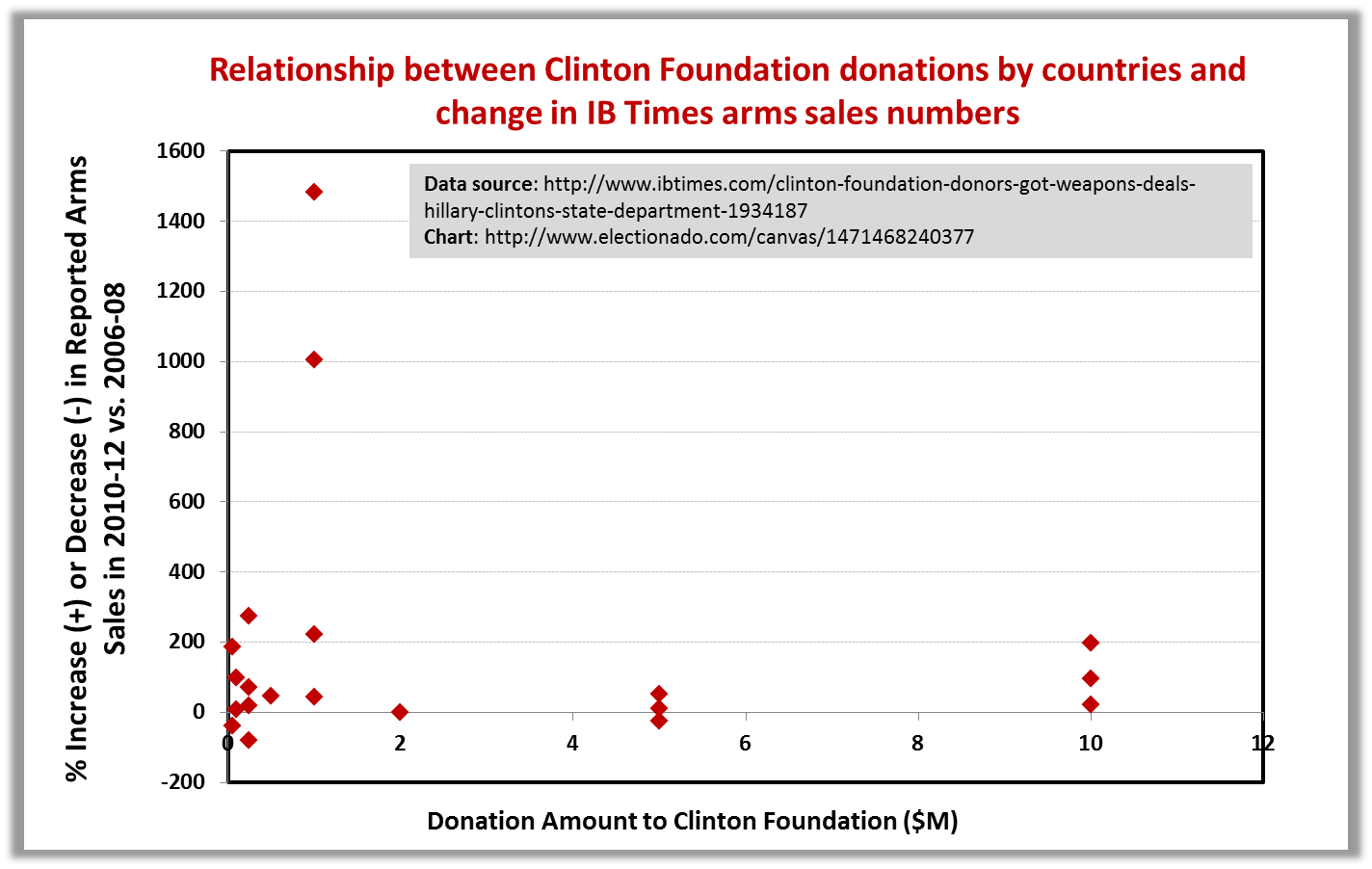
Guns For Sale!

Did Clinton's State Dept collude with the Clinton Foundation to sell more arms to countries that donated to the Clinton Foundation?

No.

Next bullshit, please.

Better Than Winning

Why would a candidate want to continue behaving in a way that fires up a very large and very committed following even if it continually hurts his chances of winning an election? And why would a candidate bring on-board a guy who created a wildly successful TV "news" empire (even if he was ousted over sexual harassment charges)? Why would that candidate also bring on-board one of the heads of a wildly successful web "news" company?

Well, maybe that candidate's real plan is to lose the election but leave himself with a rather large and very faithful following and the advice of a couple of wildly successful media guys to help him spin that following into a news-faux-tainment gig. Bigger than the typical campaign-to-Fox path. More like what Sarah Palin tried to do with her fans, after her election bid failed. She did the Fox News thing, too. But she also started TV shows about her and her family and even started her own web series where she would give her folksy bullshit wingnuttery to subscribers. She tried to become a media powerhouse. But Palin is a nitwit and doesn't have the charisma of Trump, nor does she have his bankroll.

Update:
Looks like I'm not the only person who sees this.

The Hits Keep Coming

Raleigh, N.C. — Lawmakers unconstitutionally used race when they drew legislative boundaries for state House and Senate members, a panel of three federal judges ruled Thursday afternoon.

The ruling is the latest federal ruling tossing out district lines drawn by lawmakers, and appears to mirror a decision earlier this year that rejected lines drawn for members of the U.S. House.

"Therefore, we hereby order the North Carolina General Assembly to draw remedial districts in their next legislative session to correct the constitutional deficiencies in the Enacted Plans," the court wrote.

Haha. Stupid NC GOP is getting its ass kicked this summer.

WRAL.com

Authoritative-sounding Statements

The reporter’s attorneys turned the tables and brought Trump in for a deposition.

For two straight days, they asked Trump question after question that touched on the same theme: Trump’s honesty.

The lawyers confronted the mogul with his past statements — and with his company’s internal documents, which often showed those statements had been incorrect or invented. The lawyers were relentless. Trump, the bigger-than-life mogul, was vulnerable — cornered, out-prepared and under oath.

Thirty times, they caught him.

Trump had misstated sales at his condo buildings. Inflated the price of membership at one of his golf clubs. Overstated the depth of his past debts and the number of his employees.

That deposition — 170 transcribed pages — offers extraordinary insights into Trump’s relationship with the truth. Trump’s falsehoods were unstrategic — needless, highly specific, easy to disprove. When caught, Trump sometimes blamed others for the error or explained that the untrue thing really was true, in his mind, because he saw the situation more positively than others did.

Trump: Kill Clinton or her judges

I called the office of one of my Senators, Tom Tillis (R-NC), to see what he thought of Trump’s statement, given that it was made in Wilmington NC. The staffer said he hadn’t heard anything about it yet. I explained what Trump said and the staffer sighed a bit and said “this sounds like something that’s going to get a lot of attention, so we’ll probably have a statement in the next couple of days.”

I will call back!