Category Archives: Uncategorized

The Wall

Stable. Genius.

WASHINGTON — Before it became the chief sticking point in a government shutdown drama that threatens to consume his presidency at a critical moment, President Trump’s promise to build a wall on the southwestern border was a memory trick for an undisciplined candidate.

As Mr. Trump began exploring a presidential run in 2014, his political advisers landed on the idea of a border wall as a mnemonic device of sorts, a way to make sure their candidate — who hated reading from a script but loved boasting about himself and his talents as a builder — would remember to talk about getting tough on immigration, which was to be a signature issue in his nascent campaign.

“How do we get him to continue to talk about immigration?” Sam Nunberg, one of Mr. Trump’s early political advisers, recalled telling Roger J. Stone Jr., another adviser. “We’re going to get him to talk about he’s going to build a wall.”

Completism

Years ago we took all our hundreds of CDs out of their jewel cases and put them in vinyl sleeves. This saved an enormous amount of space and weight when we were moving - what took tens of shelves to store now fit in a couple small boxes. And as we were doing that, we ripped a lot of those CDs to MP3, but not all.

And, for six years, music has been sitting in the closet, out of sight. Not out of mind. Wouldn't that bother you? It bothered me, from time to time anyway. What am I missing? I never ripped that Buddy Miller CD? There was a persistent and bothersome hole in my digital collection exactly the same shape as that first full-length Sonic Youth record (which I can't stand, but dammit, I know I have it) !

It bothered Mrs, too. A few months back, she went through the boxes of CDs, pulled out all of her stuff, ripped what she wanted and then threw them out. I cringed at the last step.

But this week I finally went through the remainder and ripped all the CDs that hadn't been ripped already.

There were a lot fewer than I had imagined: 78 in all. I was expecting twice that. What wasn't surprising was that there were very very few that I think I will ever listen to. The only thing really interesting thing to me was a Peel Session CD from The Cure that I bought at a dingy little basement record store in Aachen Germany, December '88. Then there were the dozen classical CDs that my father must have dumped on me. There were several CDs of bands we saw once, while on vacation somewhere. CD singles from the early 90s. Junk from junk bands. Least-favorite records from favorite bands. Friends' bands. CDs from bands I'd heard good things about then realized I'd been mislead.

But I ripped them all, because it would be wrong to have those 780 songs sitting in the closet, never even having a chance of being scrolled past in the Sonos app. Now I can see them and remember where and why I got them, even if I never want to hear them. Satisfaction abounds.

I can't bring myself to throw the actual CDs out though. That feels like a sin.

Coincidence?

That these two stories should pop up last week?

When French politician Marine Le Pen needed cash for her far-right party, an obscure Russian bank agreed to help.

Four years later, the bank has gone bust. The owner is facing a warrant for his arrest. Former Russian military officers are demanding money. And the party’s treasurer is sending off some $165,000 every few months to a woman in Moscow, unsure of where the payments ultimately will go.

The money failed to deliver Le Pen the French presidency in last year’s election, denying the Kremlin a powerful ally in the heart of Europe. Instead, the 9.4 million-euro loan, then worth $12.2 million, dragged her party into the shadowy underworld of Russian cross-border finance, putting it in league with people accused of having ties to Russian organized crime, money laundering and military operations.

The mysterious saga of the loan offers a rare look inside the Russian influence engine, demonstrating how people, companies and networks outside the Kremlin pursue President Vladimir Putin’s foreign policy aims, often without a centralized plan.

And...

This month's three-page summary D.C. Circuit decision revealed a fairly dry set of legal issues that just might conceal a juicy core. The dry issues involved matters of jurisdiction and statutory interpretation fathomed only by elite appellate lawyers, but the potentially juicier underlying issues hinted of fascination: Somewhere, a corporation (a bank? a communications firm? an energy company?) owned by a foreign state (Russia? Turkey? Ukraine? United Arab Emirates? Saudi Arabia?) had engaged in transactions that had an impact in the United States and on matters involved in the special counsel’s investigation.

Intriguingly, the decision revealed that a regulator from Country A had filed a submission claiming that compliance with the subpoena would cause the Corporation to violate Country A’s law. So whoever Country A is, this matter captured its officials’ attention and prompted them to send filings to a faraway country to block the subpoena. Why does Country A care? And, what is it trying to hide?

I Was A Cable Guy. I Saw The Worst Of America.

Long and awesome story about things a cable tech saw on her rounds. Yikes.

I was filling out the work orders and emailing my supervisor to give him a heads-up on a possible call from a member of every cable tech’s favorite rage cult, when his wife knocked on my van window. She stepped back and called me “ma’am.” Which was nice. Her husband with the tucked-in polo shirt had asked my name and I told him Lauren. He heard Lawrence because it fit what he saw and asked if he could call me Larry. Guys like that use your name as a weapon. “Larry, explain to me why I had to sit around here from 1 to 3 waiting on you and you show up at 3:17. Does that seem like good customer service to you, Larry? And now you’re telling 7 to 10 days? Larry, I’m getting really tired of hearing this shit.” Guys like that, it was safer to just let them think I was a man.

She said she was sorry about him. I said, “It’s fine.” I said there really wasn’t anything I could do. She blinked back the flood of tears she’d been holding since God knows when. She said, “It’s just, when he has Fox, he has Obama to hate. If he doesn’t have that ...” She kept looking over her shoulder. She was terrified of him. “I’m sorry,” she said. “I just need him to have Fox.” I got out of my van.

Nearing The Inversion

How much of the internet is fake? Studies generally suggest that, year after year, less than 60 percent of web traffic is human; some years, according to some researchers, a healthy majority of it is bot. For a period of time in 2013, the Times reported this year, a full half of YouTube traffic was “bots masquerading as people,” a portion so high that employees feared an inflection point after which YouTube’s systems for detecting fraudulent traffic would begin to regard bot traffic as real and human traffic as fake. They called this hypothetical event “the Inversion.”

Professional Bankruptor Has Ideas

Why Your iPhone Selfies Don't Look Like Your Face

When a prominent YouTuber named Lewis Hilsenteger (aka “Unbox Therapy”) was testing out this fall’s new iPhone model, the XS, he noticed something: His skin was extra smooth in the device’s front-facing selfie cam, especially compared with older iPhone models. Hilsenteger compared it to a kind of digital makeup. “I do not look like that,” he said in a video demonstrating the phenomenon. “That’s weird … I look like I’m wearing foundation.”

...

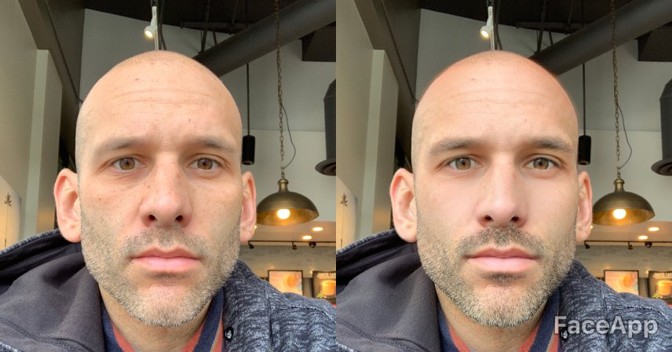
This isn’t a totally new phenomenon: Every digital camera uses algorithms to transform the different wavelengths of light that hit its sensor into an actual image. People have always sought out good light. In the smartphone era, apps from Snapchat to FaceApp to Beauty Plus have offered to upgrade your face. Other phones have a flaw-eliminating “beauty mode” you can turn on or off, too. What makes the iPhone XS’s skin-smoothing remarkable is that it is simply the default for the camera. Snap a selfie, and that’s what you get.