
Category Archives: Uncategorized
Theory of Musical Equilibration
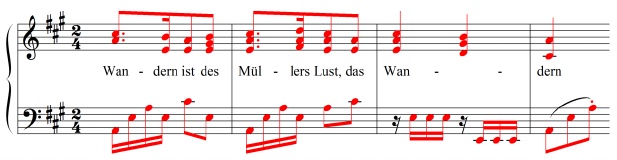
Moser's dictionary of music describes the different emotional content of major and minor chords as follows:
There is a great deal of truth to the statement that major chords sound happy and minor chords sound sad, despite the primitive nature of the idea.
The Swiss music theory expert Gustav Güldenstein described the major tonic as symbolically including an awareness of one's own will, as corresponding to a feeling of a sober-minded contentment with the present moment: The tonic can be symbolically represented by a person standing upright in life. He is at rest as long as he is not moving, yet he is under tension in that he must constantly overcome a sensation of heaviness.
The Ullstein dictionary of music also attributes this chord with the ability to communicate an intention, describing it as "affirming". Music-theory specialists concur that the third in the major tonic is a leading note which shows only a mild inclination to resolve upward. Applying the Theory of Musical Equilibration to an analysis of this leading-tone effect leads us to a logical conclusion: we identify with the desire for the third not to change. This also takes into account what Ernst Kurth described as internally translating the physical experience of the note into another essential quality.
To phrase it differently, when a major tonic sounds, we feel only a very mild desire for something indefinable and substantial to change. From an emotional perspective, we can describe this sense of will as identifying with a sober-minded sense of contentment with the here and now. This conclusion is nearly identical in content to the way Gustav Güldenstein described the major tonic above.
1.2.2 Why do minor chords sound sad?
The effect of a minor chord can also be logically explained by applying the Theory of Musical Equilibration. The Moser dictionary of music describes the nature of the minor chords as the major being clouded by the minor. When the definition is interpreted from this monistic perspective, the minor third is not seen as an independent interval, but rather as a "clouded" major third which has been robbed of its leading-note tension. The Ullstein dictionary of music describes a minor chord as a suppressed major.Upon applying the Theory of Musical Equilibration to the minor chord here, we see a clear result if we replace the mental image of Kurth's effects of equilibration (i.e. the urge for musical resolution) with the image of identifying with the desire for things to remain as they are. In a major tonic, we identified with a desire for the chord not to change, but in the minor key, that sense of will now appears clouded, suppressed. The feeling of contentment is clouded by a feeling of discontentment. The experience of listening to a minor chord can be compared to the message conveyed when someone says, "No more." If someone were to say these words slowly and quietly, they would create the impression of being sad, whereas if they were to scream it quickly and loudly, they would be come across as furious. This distinction also applies for the emotional character of a minor chord: if a minor harmony is repeated faster and at greater volume, its sad nature appears to have suddenly turned into fury.
Outrage Of The Week
Stranger Things was only eight episodes long?
W
T
F
?
Grounds For Walking Out
The office smells like old diapers this morning. Someone burned coffee.
But somehow, "burned coffee baby shit" turns up zero Google hits.
(I hereby claim the phrase)
Anti-Metal
The least metal word is particularly, followed by indicated, secretary, committee, and university.
The Earth is Not Moving!
In case you'd like some non-political lunacy in your day...
We live in a yin-yang world of duality where everything and its opposite exist together in perfect proportions like male/female, good/evil, hot/cold, knowledge/ignorance, inhale/exhale, dark/light, day/night and of course, sun and moon. Half our lives (the daytime) are ruled by the sun and half our lives (the nighttime) are ruled by the moon. When you look up at the sun and the moon they are in perfect proportion to one another as exemplified during an eclipse. But thanks to a total eclipse of the mind these nihilistic cosmologists have indoctrinated world-wide generations of people to believe Earth itself and all the planets revolve around the sun. That the sun is much larger and farther away, the moon is much smaller and closer, and it's simply our coincidental perspective here on Earth that makes them appear the same size. They have convinced us that the very Earth on which we stand is spinning beneath our feet. So next time you're wondering why it's so difficult to awaken your friends and family to the Atlantean conspiratorial matrix, consider how deep the establishment indoctrination really is, and how easy it is to convince people that up is down and down is up.
There are hundreds of comments below it, where dozens of amateur and professional physicists pop in to point out how geocentrism was thoroughly discredited hundreds of years ago. Each one is dismissed with the same stack of conspiracy theories and pseudoscience - Fake moon landing! Coriolis effect has never been proved! It's the aether! Copernican propaganda!
Good times.
Context
I find the safety obsession with self-driving cars to be amusing. Safety is the easy part. I'm sure they'll be able to make cars which drive themselves on highways and have as good or better safety records as humans in similar driving conditions. Programming them to not hit things and to avoid being hit by things is, I would guess, the simplest challenge right now.
I disagree.
Here's the scenario that convinces me otherwise:
You're driving on a residential street. It just happens that there's a birthday party in one of the houses ahead on the right. You can see a "HAPPY BIRTHDAY" banner in the front window. Cars are parked along the street, on both sides, in front of the house. Kids are playing with a ball in the front lawn.
Most human drivers will see the kids playing in the yard and will, at least a little, raise their guard. Kids, ball, street - balls have a tendency to go into streets. Maybe you slow down a bit, maybe not. But you're probably going to start paying close attention.
You keep driving. And now you're in front of the house driving between two rows of parked cars, slowed down a bit because it's narrow, plus, kids.
Suddenly, a ball appears from between two cars immediately ahead on your right, bounces once, then exits between two cars on the left. What do you do? You slow way down, or even stop, because you already know that:
- there are kids playing in front of that house
- with a ball
- that ball just bounced across the street in front of you
- kids follow balls
At 30mph, you need 45 feet to stop (not counting human reaction time, which adds another 45 feet). 45 feet is about three car lengths. I hope you had already slowed down a bit. If you didn't, you will never be able to stop in time.
In this scenario, knowing about kids and balls is what gets you to slow down enough to be able to stop in time. It's not enough to react when the ball appears. You have to actually understand the situation and prepare yourself for the worst. Dumb sensors can't do that. It takes some amount of intelligence. Would the computer in a self-driving car know how to identify "kids playing with a ball on a lawn"? Not today. In ten years? Maybe. With matter-of-life-or-death reliably? I wouldn't bet my life on it. Maybe in twenty years? But until they can, self-driving cars will have to be limited to driving impractically slow except on restricted-access highways.
We're So Vain
Love songs have always dominated the pop charts, and the current era is no exception. But today, the singer’s object of affection is very often that stunning someone they see in the mirror.
A new study reports self-regard, self-promotion, and plain old bragging are far more prominent in pop music than they were a quarter-century ago.
Troublemakers
It's as if the GOP is in the business of promoting fear of ghosts that only the GOP can exorcise.
See also: the gun manufacturers + the NRA.
(((Echoes)))
The symbol comes from right-wing blog the Right Stuff, whose podcast The Daily Shoah featured a segment called "Merchant Minute" that gave Jewish names a cartoonish "echo" sound effect when uttered. The "parenthesis meme," as Right Stuff editors call it, is a visual pun.
In Right Stuff propaganda, you'll often read that Jewish names "echo." According to the blog's lexicon page, "all Jewish surnames echo throughout history." In other words, the supposed damage caused by Jewish people reverberates from decade to decade.
In an email, the editors of the Right Stuff said it is also intended as a critique of "Jewish power." They explained further:
"The inner parenthesis represent the Jews' subversion of the home [and] destruction of the family through mass-media degeneracy. The next [parenthesis] represents the destruction of the nation through mass immigration, and the outer [parenthesis] represents international Jewry and world Zionism."
Exposed: The Secret Symbol Neo-Nazis Use to Target Jews Online
sigh