
No Free Money For You, Elon
SpaceX has requested unusually swift entry into several leading stock market indexes as a condition of its historic stock market debut. But the S&P 500 stock market index representing many of the largest profitable US companies has surprised market analysts by refusing to bend the rules for Elon Musk’s space and AI company.
The June 4 decision by S&P Dow Jones Indices—the company that creates and manages stock market indexes such as the S&P 500—means that SpaceX will not gain accelerated access to potentially billions more dollars through passive investment funds that automatically purchase shares of S&P 500 companies. Modifying the rules in response to SpaceX’s request could have also allowed leading AI companies such as OpenAI and Anthropic to gain entry not long after their own expected initial public offerings (IPOs). That possibility has now been shuttered.
The news will likely come as a relief to people concerned about passive investor money and people’s retirement savings plans having greater exposure to the market risks associated with SpaceX’s big bet on AI and speculative orbital data center plans. AI companies are generally facing more challenges in funding and building expensive AI data centers, even as they shift more of the subsidized costs of running AI services onto shocked customers through usage-based pricing.
Shocked customers indeed.
For the past year, my employer has been telling us to use more and more and more AI in our work, and into our products. We've renamed products to include "AI". But when OpenAI raised their prices, management sent us an email saying we need to tighten our belts and reduce our AI usage, and that we now have per-user caps on how much we can use. The honeymoon is over.
Money Changes Everything
It’s usually assumed that the candidate who spends the most has an electoral advantage, but physics suggests the reality is more complex. Scientists at the Complexity Science Hub (CSH) have found that political polarization behaves like a phase transition, according to a paper published in Physical Review Letters, marked by a critical campaign spending threshold. Below that threshold, social dynamics shape the outcome; exceeding that threshold deepens polarization without significantly increasing the margin of victory.
The CSH team used a statistical physics model to examine bipartisan elections, specifically 6,357 House races (with just two main candidates) spanning 435 congressional districts and 21 election cycles (1980 to 2020). They found that the tipping point is $1.8 million at the district level. (Senate and presidential campaigns have higher absolute spending.) When both parties spend less than that, community interactions shape the outcome. If just one party spends more than that, the campaign gains a decisive edge, drowning out the influence of community interactions. But if both campaigns exceed the threshold, both social influence and high spending become negligible.
Spending more and more doesn’t change the outcome, which usually falls into the 50:50 range. But it does significantly increase polarization. The authors found that the incumbency advantage is also very real, at least in the intermediate spending range. Any challenger must spend about $140,000 to unseat an incumbent, even if said incumbent spends nothing, given the baseline advantage. The scientists hope to extend their analysis to multi-party systems in European democracies to learn more about these dynamics.
Fake Classic Jazz
This person doesn't exist, never existed.

But someone has taken the time and effort to create albums and albums covers (using AI), in the style of classic 50s jazz, give them fake dates, create a fake backstory, and upload it to all the streaming platforms (who accept it unquestioningly and broadcast it to the world).
What a waste.
via Reddit
But Not For Me
It would have been Miles Davis' 100th birthday today.
And Sonny Rollins died yesterday.
So, dig:
Strawberry Mind
Let's listen to Makara!
You're welcome.
The Calhoun Effect
David Byrne
I finally got to see David Byrne last night. He's been in the area before, but I was never really interested. I'd been skeptical about his solo stuff, and considered myself a Taking Heads partisan. But, after seeing the Jerry Harrison / Adrian Belew Remain In Light tour, and seeing Byrne kill it on Saturday Night Live a couple of times over the past years, I relaxed my opposition and got with reality.
And it was tremendous.
He started with the Talking Heads' "Heaven", which got a deafening standing ovation. I was shocked. To me, apparently stuck in 1987, The Heads will always be an underground band who miraculously worked their way up to a string of late-career hits. And "Heaven" definitely wasn't one of those. Yes, it's in the Stop Making Sense movie (not the album) but it's still one of those deep album cuts that you'll never hear on the radio (does radio still exist?). But there it was, and the crowd loved it. Or loved him for playing it. Or loved him for being there. Or something. Deafening applause for "Heaven".
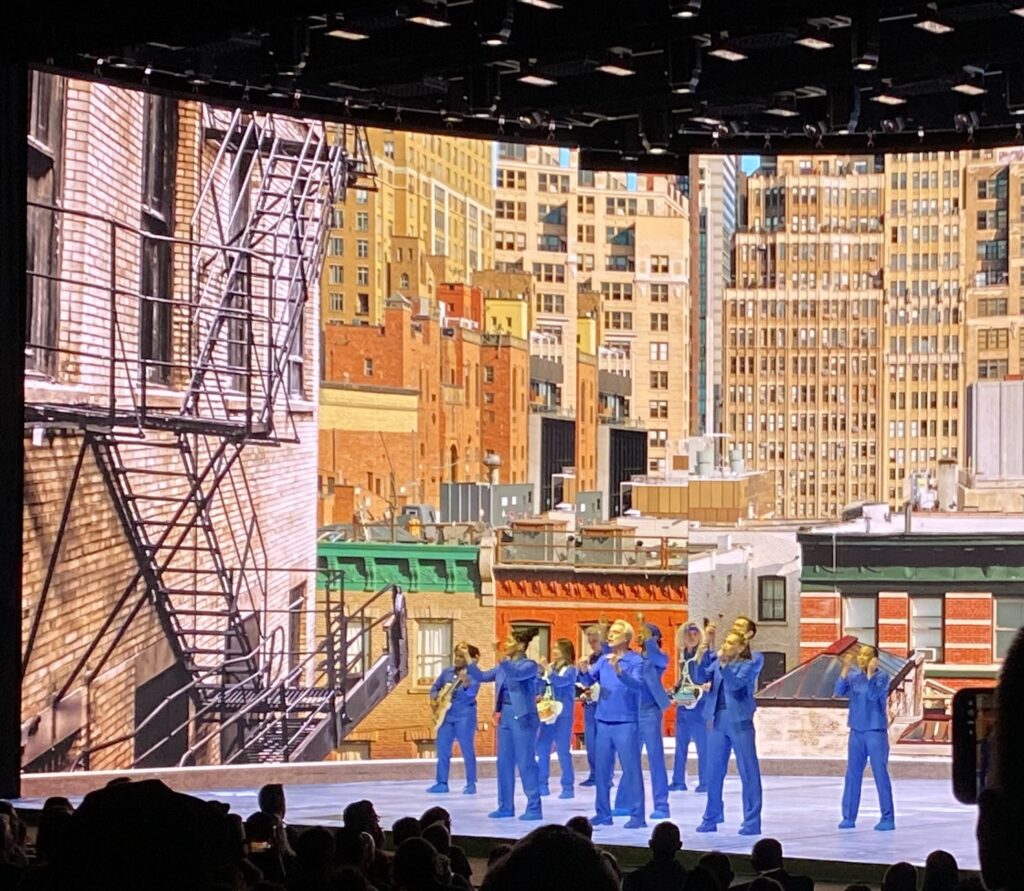
Crappy iPhone Camera
And then he basically alternated solo songs and Talking Heads songs for the next two hours. So, pretty much ideal - he did most of what you'd expect for Heads' songs : "Psycho Killer", "Life During Wartime", "Nothing But Flowers", etc., and also "Air" (??!). And his solo stuff was uniformly good, too: "Everybody Laughs" and "My Apartment is My Friend" and some others from the new album, "Independence Day" from Rei Momo, "Strange Overtones", etc..
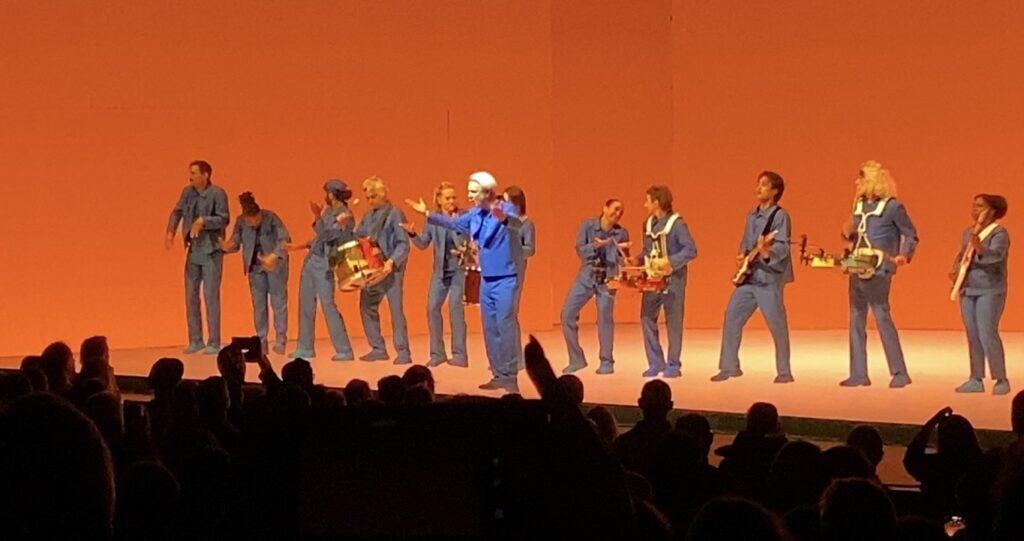
Crappy iPhone Camera
There were a dozen people on stage with him, and they were always standing, walking, dancing, marching, leaping, while playing. Nobody sat - there was nothing to sit on. Percussion was split between four people playing a mix of acoustic and electronic drums, marching-band-style. There were four backup singers / dancers, a horn player, keys, guitar, bass, etc.. Every song was choreographed, and the floor and walls -all LED displays- were frequently part of the choreography too.
There were professional videographers out in the crowd, so I assume they're making some kind of movie of it.
He's doing a second show tonight. My father drove down from upstate NY to see it.